What Are Borehole Casings and Why Do They Matter?
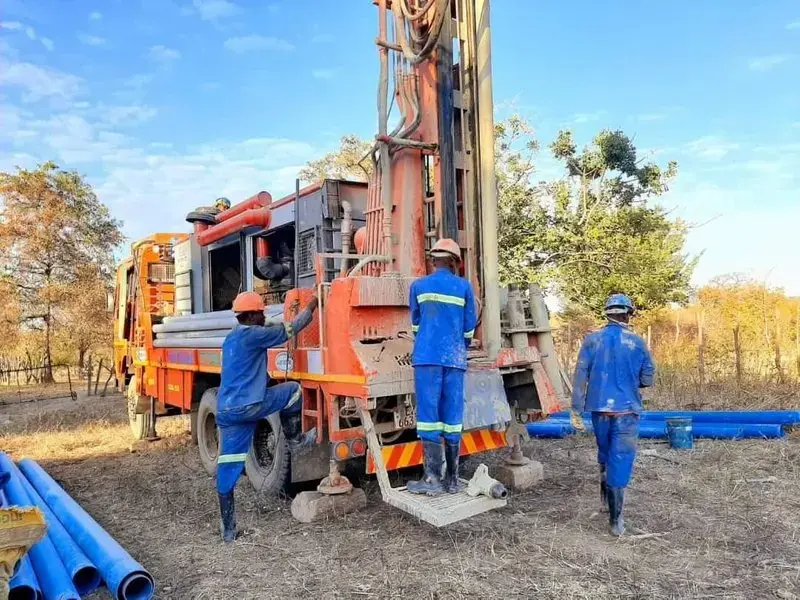
A borehole casing is a pipe that is installed in a borehole to maintain its structural integrity and prevent collapse. It is a critical component of any well, serving multiple essential functions:
- Structural support — Prevents the borehole walls from collapsing into the well, especially in loose or unstable formations.
- Contamination prevention — Seals off the upper part of the borehole to prevent surface water, contaminants, or shallow groundwater from entering the well.
- Pump installation — Provides a smooth, stable pipe through which the pump and drop pipe can be installed and retrieved.
- Screen housing — In the screened section, it supports the well screen and filter pack.
- Isolation of water-bearing zones — Allows you to isolate different water-bearing zones and only draw from the most productive or highest-quality aquifer.
Key Insight: The casing is one of the most important—and often most expensive—components of a borehole. Choosing the right material is essential for the long-term performance, safety, and longevity of your well.
In Kenya, the two most common casing materials are uPVC (unplasticised polyvinyl chloride) and steel (mild steel or stainless steel). Each has distinct advantages and limitations, and the best choice depends on several factors, including depth, geology, water chemistry, and budget.
This guide provides a comprehensive comparison of uPVC and steel casings, helping you make an informed decision for your borehole project.
uPVC Borehole Casing: Properties and Performance
uPVC (unplasticised polyvinyl chloride) is a rigid, durable plastic pipe that has become the most widely used casing material in Kenya and many other countries over the past three decades.
Advantages of uPVC Casing
- Excellent corrosion resistance — uPVC is immune to corrosion from water, soil, and most chemicals. It will not rust, scale, or degrade due to aggressive groundwater (low pH, high chlorides, or saline conditions).
- Longevity — With a lifespan of 50 years or more, uPVC casing can outlast many steel installations, especially in corrosive environments.
- Lightweight — uPVC is significantly lighter than steel, making it easier to transport, handle, and install. This also reduces installation costs.
- Smooth interior — The smooth surface of uPVC reduces friction, allowing for higher flow rates and easier pump installation.
- Cost-effective — uPVC is generally less expensive than steel, especially when considering the total lifecycle cost.
- Low maintenance — uPVC does not require painting, coating, or cathodic protection.
- Good insulation — uPVC is a poor conductor of heat and electricity, which can be an advantage in certain situations.
Disadvantages of uPVC Casing
- Lower mechanical strength — Compared to steel, uPVC has lower tensile, compressive, and collapse resistance. It can crack or deform under high external loads, such as in deep boreholes or unstable formations.
- Temperature sensitivity — uPVC can soften or deform at temperatures above 60°C. This is rarely an issue in Kenyan groundwater but may be a concern in geothermal areas.
- Susceptibility to UV degradation — uPVC should not be stored in direct sunlight for extended periods, as UV radiation can degrade the material.
- Joint integrity — While modern solvent-welded joints are strong, they require careful preparation and curing time. Threaded joints in uPVC are less reliable than steel.
- Lower resistance to point loads — A rock falling onto uPVC pipe can crack or puncture it, while steel would more likely deflect or dent.
uPVC Casing Classes
uPVC casing is classified by its pressure rating (Class). The most common classes used in Kenya are:
- Class 10 — Suitable for shallow boreholes (up to 50–80 metres) with low pressure.
- Class 20 — The most common class for residential and commercial boreholes (80–200 metres).
- Class 30 — For deeper boreholes (200–300 metres) or higher pressure requirements.
- Class 40+ — For very deep boreholes or areas with unstable ground.
The class indicates the maximum working pressure in bars. For example, Class 20 has a working pressure of 20 bar (2.0 MPa). Higher class numbers mean thicker walls and greater strength.
Steel Borehole Casing: Properties and Performance
Steel casing is the traditional material for borehole construction, made from mild steel or, for more demanding applications, stainless steel. It has been used for over a century and remains popular for deep and high-stress applications.
Advantages of Steel Casing
- High mechanical strength — Steel has excellent tensile, compressive, and collapse resistance, making it suitable for deep boreholes (over 250 metres) and unstable formations.
- Durability — In non-corrosive environments, steel casing can last 20–30 years or more.
- Threaded joints — Steel casing is typically joined with threaded connections, which are strong, reliable, and allow for easy assembly and disassembly.
- Impact resistance — Steel can withstand accidental impacts from tools, rocks, and equipment better than uPVC.
- Temperature resistance — Steel casing can withstand high temperatures, making it suitable for geothermal and industrial applications.
- Well-known standards — Steel casing is manufactured to well-established international standards (ASTM, API), ensuring consistent quality.
Disadvantages of Steel Casing
- Corrosion susceptibility — The biggest disadvantage of steel is its vulnerability to corrosion. In aggressive groundwater (low pH, high chlorides, sulphates), steel can corrode rapidly, leading to casing failure.
- Higher cost — Steel is significantly more expensive than uPVC, both in terms of material cost and installation labour.
- Heavy weight — Steel is heavy, requiring specialised equipment for transport and handling, which increases logistical costs.
- Higher friction — Steel has a rougher surface than uPVC, which can increase friction losses and reduce flow efficiency.
- Scale and encrustation — Over time, steel casings may develop scale or mineral encrustation, reducing the effective diameter and requiring maintenance.
- Protective coatings required — To extend its life, steel casing often requires protective coatings (epoxy, galvanising) or cathodic protection, adding to the cost.
Steel Casing Grades
In Kenya, the most common steel casing grades are:
- Mild Steel (MS) — The most common and economical option. It is suitable for most applications but is susceptible to corrosion. Often galvanised or coated for corrosion protection.
- Stainless Steel (SS) — Offers excellent corrosion resistance, especially grades 304 and 316. It is the material of choice for aggressive water chemistry but is significantly more expensive.
- API Grade (J55, K55, N80) — Used in deep wells and oil/gas applications. These are high-strength steels with specific mechanical properties.
uPVC vs Steel: Side-by-Side Comparison
Here is a direct comparison of uPVC and steel casing across key performance criteria:
| Feature | uPVC Casing | Steel Casing (Mild Steel) | Winner |
|---|---|---|---|
| Corrosion Resistance | Excellent — immune to most forms of corrosion | Poor — susceptible to rust and chemical attack | ✅ uPVC |
| Mechanical Strength | Good for moderate depths (≤ 250m) | Excellent — handles deep wells and heavy loads | ✅ Steel |
| Lifespan | 50+ years in most environments | 20–30 years (or less in corrosive water) | ✅ uPVC |
| Weight (per metre, 6" pipe) | ~8–12 kg | ~30–40 kg | ✅ uPVC |
| Cost (KES/m) | 800 – 1,500 | 2,500 – 5,000 | ✅ uPVC |
| Installation Ease | Lightweight, easy to handle, solvent-weld joints | Heavy, requires heavy machinery, threaded joints | ✅ uPVC |
| Joint Reliability | Good — solvent-welded joints are strong when done correctly | Excellent — threaded and coupled joints are very strong | ✅ Steel |
| Impact Resistance | Moderate — can crack under point loads | High — can withstand impacts and heavy handling | ✅ Steel |
| Temperature Tolerance | Up to 60°C | Up to 300°C+ | ✅ Steel |
| UV Resistance | Poor — must be stored out of direct sunlight | Good — no UV degradation | ✅ Steel |
| Smoothness (flow efficiency) | Very smooth — low friction | Rougher — higher friction | ✅ uPVC |
| Scale/Encrustation | Low — smooth surface resists scaling | Moderate — scaling can occur over time | ✅ uPVC |
| Environmental Impact | PVC production has environmental concerns | Steel is recyclable but energy-intensive | — (Tie) |
Summary: uPVC excels in corrosion resistance, lifespan, cost, and ease of handling, while steel wins on mechanical strength, impact resistance, and joint reliability. The right choice depends on your specific project requirements.
Cost Comparison: What You'll Pay in Kenya
Cost is often a deciding factor. Here is a detailed breakdown of casing costs for a typical borehole in Kenya (150–200 metres depth, 6-inch diameter):
| Item | uPVC (Class 20) | Steel (Mild Steel, 6mm wall) | Stainless Steel (304) |
|---|---|---|---|
| Material cost (per metre) | KES 800 – 1,200 | KES 2,500 – 3,500 | KES 4,500 – 6,500 |
| Cost for 180m casing | KES 144,000 – 216,000 | KES 450,000 – 630,000 | KES 810,000 – 1,170,000 |
| Joints/accessories | KES 15,000 – 25,000 | KES 30,000 – 50,000 | KES 50,000 – 80,000 |
| Installation labour | KES 20,000 – 35,000 | KES 40,000 – 60,000 | KES 50,000 – 70,000 |
| Transport & handling | KES 10,000 – 20,000 | KES 25,000 – 40,000 | KES 30,000 – 50,000 |
| Total estimated cost | KES 189,000 – 296,000 | KES 545,000 – 780,000 | KES 940,000 – 1,370,000 |
Budget Note: These are indicative 2026 prices. Actual costs vary by supplier, quantity, and location. uPVC is typically 60–70% less expensive than mild steel casing and 80–85% less than stainless steel.
While the upfront cost of steel is significantly higher, some clients choose it for deep or high-stress applications where uPVC may not be suitable. In many residential and commercial boreholes in Kenya (under 200 metres), uPVC is the more cost-effective choice.
Installation and Handling Differences
The installation process differs significantly between uPVC and steel casing:
uPVC Casing Installation
- Handling — Lightweight sections can be carried by hand; no heavy lifting equipment required.
- Joining — Solvent-welded joints are quick and create a strong, watertight seal. The process requires clean, dry surfaces and proper curing time.
- Cutting — Can be cut easily with a hand saw or power saw.
- Lowering — The lightweight nature makes it easier to lower into the borehole.
- Centralisers — uPVC casing requires centralisers to keep it centered in the borehole and prevent damage during installation.
Steel Casing Installation
- Handling — Heavy sections require lifting equipment (cranes, forklifts, etc.).
- Joining — Threaded and coupled joints are strong but require careful threading, coating (thread compound), and torquing. This is a more time-consuming process.
- Cutting — Requires specialised cutting equipment (saws, torches).
- Lowering — The heavy weight means the casing must be carefully supported during lowering to avoid collapse or buckling.
- Centralisers — Also required for steel casing to ensure uniform annular space for grouting.
- Protective coating — If mild steel, it may need to be coated with epoxy or bitumen before installation.
The installation of steel casing is more labour-intensive, requires more specialised equipment, and typically takes longer than uPVC installation. This contributes to the higher overall cost.
Kenya-Specific Considerations
When choosing casing for a borehole in Kenya, several local factors come into play:
- Groundwater chemistry — Kenya's groundwater quality varies widely. In coastal areas, saline water is common, which is highly corrosive to steel. In volcanic areas (like Nairobi), groundwater often has low pH (acidic), which can also attack steel. uPVC is the preferred choice in these environments.
- Geological conditions — In areas with unstable ground, high external pressure, or deep boreholes (e.g., parts of the Rift Valley), steel casing's superior strength is an advantage.
- Depth — Most residential and commercial boreholes in Kenya are between 120 and 250 metres deep. uPVC Class 20 or 30 is suitable for these depths in stable formations. For depths exceeding 250 metres, steel is often recommended.
- Cost sensitivity — For many Kenyan homeowners and businesses, the cost savings of uPVC are a significant factor. The lower material and installation costs make boreholes more accessible.
- Availability — Both uPVC and steel casing are readily available in Kenya through major suppliers. uPVC is more widely stocked in sizes and classes commonly used for residential boreholes.
- Local expertise — Kenyan drillers are highly experienced with both materials. However, the skill level for uPVC jointing is widely available, while steel jointing requires more specialised training.
WaterLink Experience: In our 30+ years of drilling in Kenya, we have installed over 1,100 boreholes using uPVC casing and over 200 using steel casing. Our experience shows that uPVC is the preferred choice for the majority of residential and commercial projects, while steel is selected for deep (>250m), high-pressure, or geothermally active sites.
Recommendations by Borehole Type and Use
Based on our extensive experience, here are our recommendations:
| Borehole Type | Depth Range | Recommended Casing | Notes |
|---|---|---|---|
| Residential (home) | 80 – 200 m | uPVC Class 20 | Cost-effective, corrosion-proof, adequate strength |
| Commercial / Schools / Apartments | 120 – 250 m | uPVC Class 20 or 30 | Class 30 for depths >200m; steel if water is highly aggressive |
| Agricultural / Irrigation | 100 – 300 m | uPVC Class 30 or Steel | Steel recommended for deep high-yield wells |
| Deep boreholes (>250m) | 250 – 400+ m | Steel (mild or stainless) | Steel provides the necessary strength and collapse resistance |
| Geothermal / Hot water | 100 – 300 m | Steel (stainless preferred) | uPVC cannot withstand high temperatures |
| Coastal / Saline areas | 80 – 200 m | uPVC Class 30 or Stainless Steel | Mild steel will corrode rapidly in saline water |
| Unstable / Collapsing formations | Any depth | Steel (with heavy wall) | Steel provides better support to prevent collapse |
WaterLink Standard: For the vast majority of residential and commercial boreholes in Kenya (under 250 metres), we recommend uPVC Class 20 or 30 casing. It provides excellent corrosion resistance, long life, and significant cost savings compared to steel.
Making the Right Choice: Key Decision Factors
To decide between uPVC and steel casing, consider these factors in order of importance:
- Water chemistry — If your groundwater is acidic (pH < 6.5), saline, or has high chloride or sulphate levels, uPVC (or stainless steel) is essential. Mild steel will corrode, potentially failing within a few years.
- Borehole depth — For depths up to 250 metres with stable formations, uPVC Class 20 or 30 is adequate. Beyond 250 metres, steel is generally required for its superior collapse resistance.
- Geological stability — If the formation is prone to collapse (e.g., loose sands, gravels, or weathered zones), steel casing's greater strength provides better protection.
- Temperature — If the groundwater temperature exceeds 60°C, uPVC is not suitable. This is rare in Kenya but can occur in geothermal areas.
- Budget — If cost is a major constraint, uPVC is significantly more affordable, both upfront and over the lifecycle.
- Maintenance — uPVC requires virtually no maintenance, while steel may need periodic inspection for corrosion, especially in aggressive environments.
- Project timeline — uPVC installation is generally faster, which can be important for projects with tight schedules.
By weighing these factors, you can make an informed decision that balances performance, longevity, and cost. WaterLink Limited is always available to provide expert advice based on your specific site conditions.
WaterLink Limited's Approach to Casing Selection
WaterLink Limited has been at the forefront of borehole construction in Kenya for over three decades. Our approach to casing selection is based on technical excellence, local experience, and a commitment to our clients' long-term water security:
- Site assessment — We conduct thorough geological and hydrogeological investigations, including water quality testing, to understand the specific conditions of your site.
- Expert recommendation — Based on the assessment, we recommend the optimal casing material and class for your borehole. We never use a "one-size-fits-all" approach.
- Quality materials — We source only high-quality uPVC casing (Class 20, 30, or higher) and steel casing (mild or stainless) from reputable manufacturers, ensuring consistent quality and compliance with international standards.
- Professional installation — Our experienced installation teams follow best practices for casing installation, whether it's uPVC solvent-welded joints or steel threaded connections. We ensure every joint is properly made and tested.
- Warranty and support — We stand behind our work with comprehensive warranties on materials and workmanship, providing peace of mind to our clients.
- Track record — With over 1,150 boreholes completed and a 98% success rate, our expertise in casing selection and installation is proven.
Ready to drill your borehole? Contact WaterLink Limited today for a free consultation and expert recommendation on the best casing material for your project. We'll help you make the right choice for your budget and long-term water security.
Choosing the right casing is one of the most important decisions in borehole construction. With WaterLink Limited, you can be confident that your borehole is built to last, using the best materials and techniques for your specific conditions.