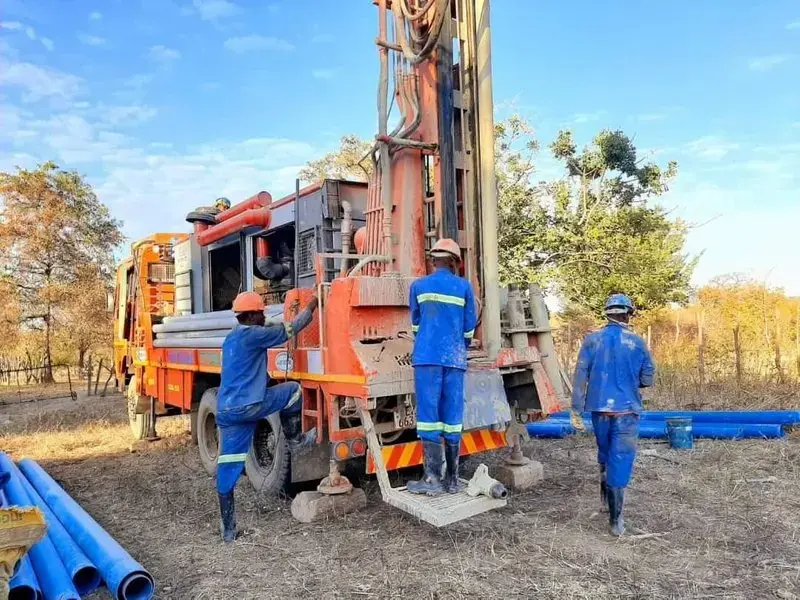
What Determines the Price Per Meter?
Understanding the borehole drilling price per meter in Kenya is essential for accurately budgeting your water project. At WaterLink Limited, a WRA licensed borehole drilling company with Class A status, we believe in complete transparency, and this guide breaks down exactly what you pay for when you see a borehole cost per meter quoted.
The price per meter is not a fixed number—it varies based on several critical factors:
- Geological Formation: Hard volcanic rock (common in Nairobi and Kajiado) requires more powerful equipment and time, raising the cost per meter.
- Depth: Deeper boreholes often have a lower per-meter rate because mobilization and setup costs are spread over more meters.
- Location: Remote areas incur higher logistics and mobilization fees.
- Casing Material: Steel casing costs more than uPVC but offers better durability for deep, high-pressure aquifers.
- Drilling Method: DTH (Down-The-Hole) drilling is faster in hard rock but more expensive than mud rotary in softer formations.
Pro Tip: Always ask for an itemized quote that breaks down drilling, casing, test pumping, and pump installation separately. A low per-meter rate often hides expensive extras.
Average Price Per Meter by Geological Formation
Different rock types require different drilling techniques and equipment, significantly affecting the cost of drilling borehole Kenya. Here's what you can expect in 2026:
| Geological Formation | Price Per Meter (KES) | Typical Regions | Drilling Method |
|---|---|---|---|
| Sedimentary / Soil | 5,000 – 7,500 | Coastal areas, parts of Rift Valley | Mud Rotary |
| Weathered Volcanic | 7,000 – 10,000 | Kiambu, Ruiru, parts of Machakos | Mud Rotary / DTH |
| Hard Volcanic (Nairobi Stone) | 10,000 – 15,000 | Nairobi, Kajiado, Ngong | DTH |
| Granite / Basalt | 12,000 – 18,000 | Parts of Machakos, Eastern Kenya | DTH |
Note: These prices are for drilling and basic casing only. Additional services like test pumping, permits, and pump installation are usually quoted separately.
Price Per Meter by Depth Range
As depth increases, the per-meter rate often decreases because mobilization and setup costs are amortized over more meters. Here's a typical pricing curve for borehole drilling rates Kenya:
| Depth Range | Price Per Meter (KES) – Hard Volcanic | Price Per Meter (KES) – Sedimentary |
|---|---|---|
| 0 – 100 meters | 12,000 – 15,000 | 6,000 – 8,000 |
| 100 – 200 meters | 10,000 – 13,000 | 5,500 – 7,500 |
| 200 – 300 meters | 9,000 – 12,000 | 5,000 – 7,000 |
| 300+ meters | 8,000 – 11,000 | 4,500 – 6,500 |
Regional Price Variations Across Kenya
Location significantly impacts the final borehole drilling cost. Here's what you can expect in different regions:
Nairobi Metropolitan Area
- Karen, Lang'ata, Runda: KES 10,000 – 15,000/m (hard volcanic rock, deep aquifers).
- Westlands, Parklands: KES 9,000 – 13,000/m.
- Eastlands (Umoja, Buruburu): KES 9,000 – 12,000/m.
Kajiado County
- Kitengela, Ongata Rongai: KES 8,000 – 12,000/m (moderate volcanic rock).
- Ngong: KES 10,000 – 14,000/m (harder rock near the hills).
Machakos County
- Athi River, Syokimau: KES 7,500 – 11,000/m (mixed geology, some clay).
- Machakos Town, Kangundo: KES 8,000 – 12,000/m.
Kiambu County
- Ruiru, Thika: KES 7,000 – 10,000/m (more sedimentary formations).
- Limuru, Kikuyu: KES 8,500 – 12,000/m.
Our Advice: Always get a site-specific quotation. Two properties just a few kilometers apart can have completely different geology and drilling costs.
What's Included in the Per Meter Rate?
A transparent drilling company will clearly state what's included in the borehole price per meter. Typically, it covers:
- Drilling labor and rig operation – The actual drilling process.
- Basic casing materials – Usually uPVC casing for the depth drilled.
- Drilling fluid (mud) for mud rotary – For stabilising the hole.
- Wear and tear on drill bits – Especially important in hard rock.
What is NOT included (and should be quoted separately):
- Hydrogeological survey – KES 50,000 – 150,000.
- WRA / NEMA permits – KES 30,000 – 80,000.
- Mobilization / demobilization – Transporting rig to your site (KES 50,000 – 150,000).
- Test pumping – KES 80,000 – 150,000.
- Pump and installation – KES 150,000 – 600,000+.
- Elevated tank and distribution – If required.
At WaterLink Limited, we provide an itemized quotation so you know exactly what you're paying for. No hidden fees.
Hidden Costs to Watch Out For
Some contractors quote a low per-meter rate but add expensive extras. Be aware of these common pitfalls when comparing borehole drilling quotes Kenya:
- Mobilization fees: Some companies charge separately for transport even if they're local.
- Extra casing: If the borehole requires deeper casing than the standard allowance, they may charge extra per meter.
- Abandoned holes: If the first hole fails, you may be charged for redrilling.
- Test pumping: Often not included in the initial quote.
- Water quality testing: Required for drinking water but often overlooked.
How to protect yourself: Always get a written quote that includes all stages of the project. Ask for a fixed-price contract where possible. WaterLink Limited provides comprehensive, transparent pricing with no surprises.
How to Get the Best Value for Your Money
Cheapest isn't always best. Here's how to ensure you get quality work at a fair price:
- Check the company's track record: Look for a 98%+ success rate, like WaterLink Limited.
- Ask about equipment: Modern DTH rigs and mud rotary capabilities ensure faster, cleaner drilling.
- Request references: Talk to past clients in your area.
- Verify licenses: Ensure the company is WRA and NEMA compliant.
- Get multiple quotes: Compare itemized quotes, not just the per-meter rate.
WaterLink Limited Advantage: We combine scientific surveying, modern rigs, full permit management, and transparent pricing to deliver the best value in Kenya.