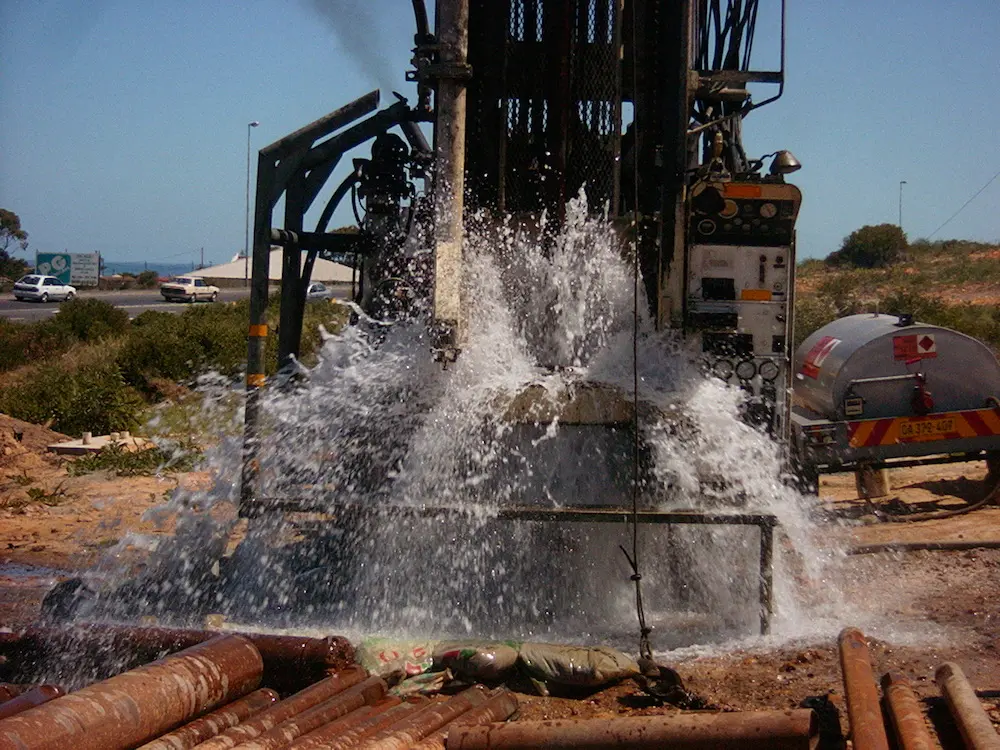
What is Borehole Development?
Borehole development is the critical process of cleaning a newly drilled borehole to remove drilling fluids, cuttings, and fine particles that have accumulated around the screen and in the surrounding formation. This process transforms a "drilled hole" into a functional water well by opening up the aquifer to allow water to flow freely into the borehole.
At WaterLink Limited, a WRA licensed borehole drilling company with Class A status, we use professional development methods on every borehole we drill. This guide explains the three main borehole development methods—surge block, air lift, and jetting—and why proper development is essential for maximizing yield and ensuring long-term performance.
Key Fact: Without proper development, a borehole's yield can be reduced by 30-50%. Development is not optional—it's essential for a productive well.
Why Borehole Development is Critical
During drilling, the borehole is filled with drilling fluids (mud) to stabilize the hole and carry cuttings to the surface. This drilling mud invades the formation and coats the screen, blocking water flow. Here's why development is essential:
- Removes Drilling Mud: Drilling fluids left in the formation will permanently reduce water flow.
- Cleans Screen Openings: The borehole screen must be completely clean for water to enter.
- Opens Aquifer Channels: Development helps create flow paths from the aquifer to the borehole.
- Removes Fine Particles: Sand, silt, and clay particles that can block the screen are flushed out.
- Maximizes Yield: Proper development ensures the borehole achieves its full potential.
- Prevents Premature Failure: A poorly developed borehole may fail within months.
- Ensures Long-Term Performance: Well-developed boreholes perform consistently for decades.
Warning: Some contractors skip development or perform minimal development to save time. This is a major red flag—a borehole that isn't properly developed will never produce its full yield.
The Three Main Development Methods
WaterLink Limited uses three proven development methods, often in combination:
Surge Block Development
A surge block (or surge plunger) is moved up and down inside the borehole, creating alternating positive and negative pressure that flushes fine particles through the screen.
- Best For: Removing fine particles from the screen
- Effectiveness: High for screen cleaning
Air Lift Development
Compressed air is injected into the borehole, creating a powerful upward flow that lifts water, drilling mud, and debris out of the borehole at high velocity.
- Best For: Removing drilling mud and large debris
- Effectiveness: Excellent for initial cleaning
Jetting Development
High-pressure water jets are directed at the screen to dislodge particles and clean the screen openings. Often combined with surging.
- Best For: Final screen cleaning and finishing
- Effectiveness: Good for screen opening cleaning
WaterLink Approach: We typically use a combination of methods—air lift for initial mud removal, surge block for screen cleaning, and jetting for final finishing. This combination delivers the best results.
Surge Block Development
The surge block (also called a surge plunger) is a tool with rubber flanges that fits tightly inside the casing. It's moved up and down rapidly within the screened interval, creating alternating positive and negative pressure surges.
How It Works
- Downward stroke: Creates positive pressure that forces water and particles outward through the screen
- Upward stroke: Creates negative pressure that pulls water and particles inward through the screen
- Continuous surging: This back-and-forth action breaks up mud cakes and flushes particles from the formation
Advantages
- Highly effective for screen cleaning
- Does not require compressed air equipment
- Can be used in deep boreholes
- Relatively gentle on the formation
Limitations
- Less effective for removing drilling mud from the formation
- Requires access to the borehole (pump removed)
- Can be time-consuming for deep boreholes
Technical Note: Surge block development is often used as the primary method for screen cleaning. At WaterLink Limited, we use this method on every borehole we drill.
Air Lift Development
The air lift method uses compressed air injected at the bottom of the borehole. The air mixes with water, reducing its density and creating an upward flow that carries drilling mud, debris, and fine particles out of the borehole.
How It Works
- Compressed air is injected through an air line to the bottom of the borehole
- Air bubbles mix with water, creating a low-density column
- The pressure difference between the column and the surrounding water creates upward flow
- Water, mud, and debris are lifted to the surface at high velocity
Advantages
- Excellent for removing drilling mud and large debris
- Can handle high sediment loads
- Effective for developing the formation
- Can be used to pump water for test pumping
Limitations
- Requires compressed air equipment (air compressor)
- Less effective for fine screen cleaning
- Can cause turbulence that damages sensitive formations
WaterLink Practice: We typically use air lift development immediately after drilling to remove drilling mud and prepare the borehole for surge block development.
Jetting Development
Jetting uses high-pressure water jets directed at the screen to dislodge particles and clean the screen openings. The jetting tool is moved up and down through the screen interval while high-pressure water is directed outward through the screen.
How It Works
- A jetting tool with high-pressure nozzles is lowered into the borehole
- Water is pumped at high pressure (100-300 psi) through the nozzles
- The jets are directed at the screen openings to flush out particles
- Dislodged particles are carried to the surface by the return flow
Advantages
- Highly effective for cleaning screen openings
- Can be combined with surging for maximum effect
- Good for removing fine particles
Limitations
- Requires high-pressure pumping equipment
- Less effective for removing drilling mud from the formation
- Not suitable for all formation types
WaterLink Practice: We use jetting as a finishing step after surge block development to ensure every screen opening is clean and free of particles.
Method Comparison
Here's a quick comparison of the three development methods:
| Feature | Surge Block | Air Lift | Jetting |
|---|---|---|---|
| Best For | Screen cleaning | Mud removal | Final cleaning |
| Mud Removal | Fair | Excellent | Poor |
| Screen Cleaning | Excellent | Good | Excellent |
| Formation Development | Good | Excellent | Fair |
| Equipment Required | Surge block, hoist | Air compressor, air line | High-pressure pump, jetting tool |
| Typical Cost | KES 80,000 – 120,000 | KES 100,000 – 160,000 | KES 90,000 – 140,000 |
Note: WaterLink Limited often combines all three methods for optimal results.
The Development Process
Here's how WaterLink Limited develops a borehole:
Initial Air Lift
We use air lift to remove drilling mud and large debris immediately after drilling. This prepares the borehole for further development.
Surge Block Development
We surge the screen interval intensively to break up mud cakes and flush fine particles through the screen.
Jetting (Optional)
For final cleaning, we use high-pressure jetting to ensure every screen opening is completely clear.
Final Air Lift
We use air lift to remove any remaining debris and confirm the borehole is clean.
Clear Water Flow
Development continues until the water being pumped is completely clear of sediment and drilling mud.
WaterLink Standard: We develop every borehole until the water runs completely clear. This can take several hours but is essential for long-term performance.
Development Costs in Kenya
The cost of borehole development depends on the depth, method, and time required:
| Development Method | Typical Cost (KES) | Time Required |
|---|---|---|
| Air Lift Only | 60,000 – 100,000 | 2-4 hours |
| Surge Block Only | 80,000 – 120,000 | 3-6 hours |
| Jetting Only | 90,000 – 140,000 | 2-4 hours |
| Combined (Air Lift + Surge + Jetting) | 120,000 – 200,000 | 6-12 hours |
Note: Costs vary based on borehole depth, accessibility, and specific conditions.
ROI Insight: Spending KES 150,000 on proper development can increase your borehole yield by 30-50%—a KES 500,000 increase in water value over the borehole's life.
What Happens If Development is Skipped?
Some contractors skip development to save time and money. Here's what happens when development is inadequate:
- Reduced Yield: Flow rates can be 30-50% lower than potential.
- Sediment in Water: Fine particles continue to enter the borehole, causing cloudy water.
- Premature Pump Failure: Sediment damages pump impellers.
- Screen Clogging: Over time, particles pack against the screen, further reducing flow.
- Borehole Failure: In severe cases, the borehole may stop producing water entirely.
- Higher Electricity Costs: The pump works harder to produce less water.
Warning: If a contractor offers to skip development or does a "quick" development in under an hour, they're not doing the job properly. Proper development takes hours.
How WaterLink Limited Develops Boreholes
WaterLink Limited uses professional development methods on every borehole we drill:
- Combined Approach: We use all three methods—air lift, surge block, and jetting—for optimal results.
- Professional Equipment: We use professional surge blocks, air compressors, and high-pressure pumps.
- Experienced Technicians: Our technicians are trained in all development methods.
- Clear Water Standard: We develop until the water runs completely clear.
- Documentation: We document the development process and include it in our project report.
Need a Properly Developed Borehole?
Contact WaterLink Limited for professional borehole drilling and development.
Request a Quote