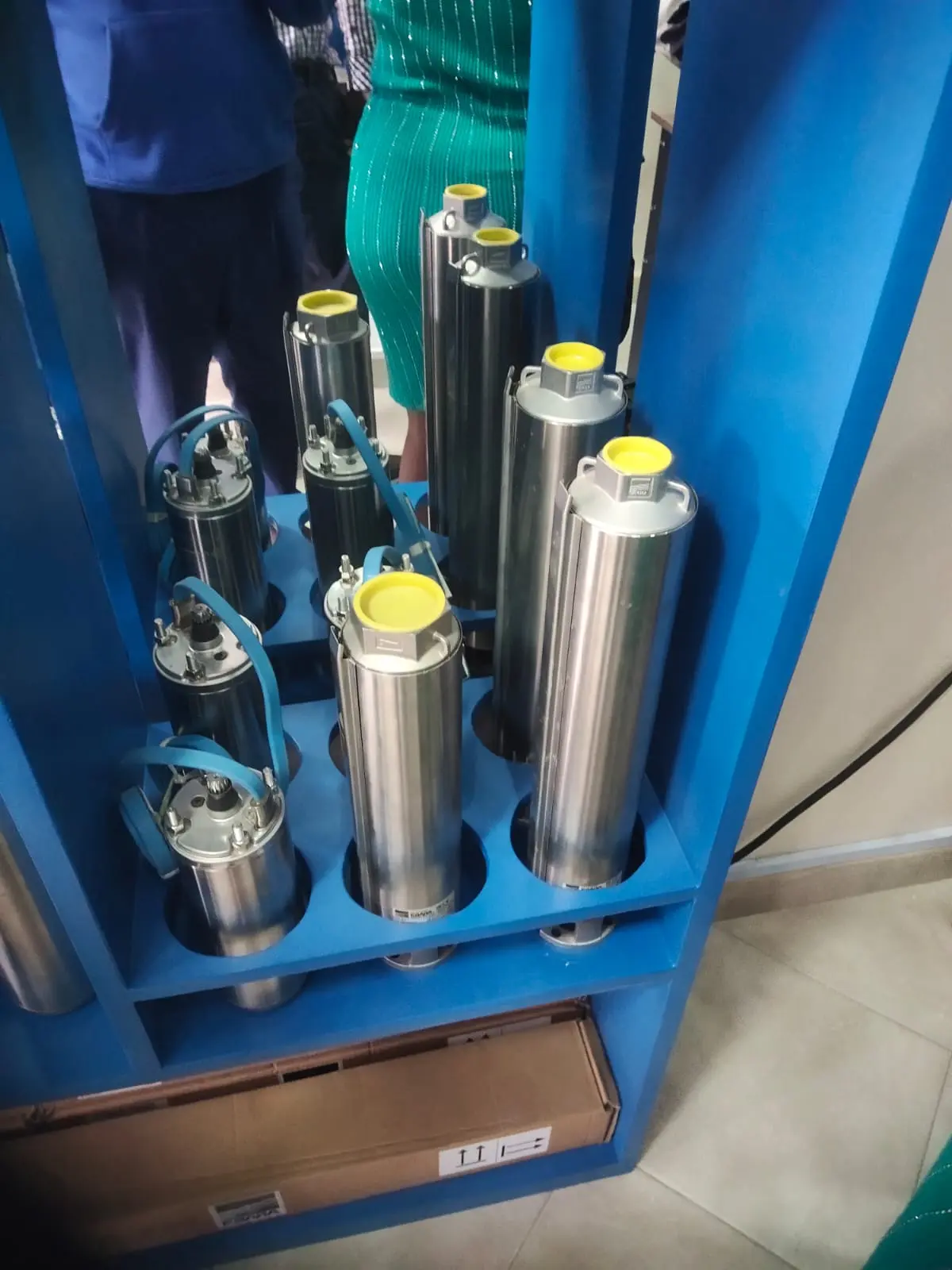
What is Test Pumping?
Test pumping is the most critical step after drilling a borehole. It involves pumping water from the borehole at a controlled rate while continuously measuring water levels. This procedure determines the borehole's sustainable yield—the amount of water you can reliably pump over the long term without depleting the aquifer.
At WaterLink Limited, a WRA licensed borehole drilling company with Class A status, we conduct rigorous 24-hour test pumping on every borehole we drill. This is not optional—it's essential for protecting your investment and ensuring your borehole delivers water for decades.
According to the Water Resources Authority (WRA), proper test pumping is mandatory for all borehole permit applications. The WRA requires a minimum 24-hour pumping test to determine sustainable abstraction rates and ensure groundwater resource protection.
Key Fact: A proper 24-hour test pumping reveals the true sustainable yield of your borehole. Without it, you're guessing—and guessing wrong can cost you millions.
Why Short Tests Are a Sales Trick
Some contractors offer 1-2 hour "test pumping" as a cost-cutting measure. Here's why this is a dangerous sales trick that can destroy the value of your borehole:
A Short Test Only Shows Initial Drawdown
When you start pumping a borehole, the water level drops quickly (drawdown). In the first 1-2 hours, this drop is rapid and dramatic. A short test only measures this initial drawdown—not the equilibrium level that determines sustainable yield.
The Hidden Danger: Progressive Drawdown
Some boreholes appear to have excellent yield in the first few hours but show progressive drawdown over 6-12 hours. This means the aquifer is depleting faster than it can recharge. A short test misses this entirely.
Real Data: Short Tests Overestimate Yield
Our data shows that short 1-2 hour tests overestimate sustainable yield by 30-50% on average. This means:
- Your pump may be oversized and will run dry
- Your borehole may fail within months or years
- You'll waste money on an oversized pump and installation
- You risk damaging the aquifer through over-extraction
Why Contractors Push Short Tests
- Lower cost: They can quote a lower price (but hide the true cost of failure)
- Faster completion: They can move to the next job sooner
- No guarantee: When the borehole fails, they blame "aquifer depletion"
- Ignorance: Some contractors simply don't understand hydrogeology
Warning: A 1-2 hour test is NOT a real test. It's a checklist item designed to make you feel like the work was done. If your contractor offers a short test, find another contractor.
What a Proper 24-Hour Test Reveals
A proper 24-hour test pumping provides critical data that short tests cannot capture:
1. Sustainable Yield (Q)
The maximum pumping rate that can be sustained without depleting the aquifer. This is the single most important number from the test.
2. Drawdown (s)
The drop in water level during pumping. A proper test measures drawdown over 24 hours to see if the water level stabilizes or continues to decline.
3. Recovery Rate
After pumping stops, we measure how quickly the water level recovers. This indicates the aquifer's recharge capacity.
4. Transmissivity (T)
A measure of the aquifer's ability to transmit water. This determines long-term performance and helps size the pump correctly.
5. Specific Capacity
The yield per unit of drawdown (Q/s). This indicates borehole efficiency and helps predict performance over time.
6. Static Water Level
The natural water level in the borehole when not pumping. This is measured before and after the test.
7. Water Quality Changes
Over 24 hours, we can detect changes in water quality that might indicate contamination or aquifer boundary effects.
Data-Driven Fact: 24-hour test data allows hydrogeologists to calculate the Radius of Influence of your borehole—essential for determining if neighboring boreholes will be affected.
Step-by-Step 24-Hour Test Process
Here's how WaterLink Limited conducts a proper 24-hour test pumping:
Step 1: Pre-Test Setup
- Install a temporary test pump at the correct depth
- Set up a flow meter to measure pumping rate
- Install a water level logger (transducer) to continuously monitor drawdown
- Record the static water level before pumping starts
Step 2: Pumping Phase (24 Hours)
- Start pumping at a constant rate (determined by the hydrogeologist)
- Record water level drawdown every 5 minutes for the first hour, then every 30 minutes for the remaining 23 hours
- Monitor pumping rate continuously to ensure it stays constant
- Document any changes in water quality, color, or sediment
Step 3: Recovery Phase (24 Hours)
- Stop pumping and immediately begin recording water level recovery
- Record recovery every 5 minutes for the first hour, then every 30 minutes
- Continue until the water level returns to the static level (or stabilizes)
- This phase is just as important as the pumping phase
Step 4: Data Analysis
- Plot drawdown vs. time on semi-logarithmic graphs
- Calculate transmissivity, hydraulic conductivity, and storativity
- Determine the sustainable yield with a safety factor
- Prepare a detailed test report with all findings and recommendations
WaterLink Standard: We follow ISO 14686:2003 and WRA guidelines for all test pumping. Our reports are accepted by WRA and NEMA for permit applications.
Test Duration Comparison
The difference between a short test and a 24-hour test is not just time—it's the reliability of your borehole's future performance.
| Test Parameter | 1-2 Hour Test | 4-6 Hour Test | 24-Hour Test |
|---|---|---|---|
| Drawdown Stabilization | ✗ Not reached | ✗ Rarely reached | ✓ Achieved |
| Aquifer Recharge Rate | ✗ Unknown | ✗ Partially known | ✓ Accurately measured |
| Sustainable Yield | ✗ Overestimated | ✗ Overestimated | ✓ Accurately determined |
| Transmissivity | ✗ Not calculable | ✗ Approximate | ✓ Accurately calculated |
| Recovery Rate | ✗ Incomplete | ✗ Partial | ✓ Complete |
| WRA Compliance | ✗ Non-compliant | ✗ May be rejected | ✓ Fully compliant |
| Reliability of Results | ✗ Very low | ✗ Moderate | ✓ High confidence |
Conclusion: Only a 24-hour test provides reliable, WRA-compliant data for your borehole.
Cost of Proper Test Pumping in Kenya
Investing in proper test pumping is far cheaper than the cost of failure. Here's the breakdown:
Typical Costs for 24-Hour Test Pumping
- Equipment rental (pump, generator, flow meter, logger): KES 40,000 – 80,000
- Hydrogeologist supervision: KES 30,000 – 50,000
- Data analysis and reporting: KES 20,000 – 40,000
- Total typical cost: KES 90,000 – 170,000
Cost Comparison: Test Pumping vs. Borehole Failure
| Scenario | Approximate Cost |
|---|---|
| 24-Hour Test Pumping | KES 90,000 – 170,000 |
| Over-sized Pump (wasted money) | KES 150,000 – 300,000 |
| Borehole Failure / Dry Hole | KES 800,000 – 2,000,000+ |
| New Borehole Drilling | KES 900,000 – 2,500,000 |
| Lost Time & Business Disruption | Priceless |
ROI Insight: Spending KES 150,000 on a proper test protects your KES 1.5 million borehole investment. The ROI is 10x or more.
WRA Requirements and Standards
The Water Resources Authority (WRA) has strict requirements for borehole testing. Here's what you need to know:
- Minimum 24 hours: The WRA requires a minimum 24-hour pumping test for all borehole permit applications.
- Constant pumping rate: The pumping rate must remain constant throughout the test.
- Drawdown measurements: Water levels must be recorded at specified intervals.
- Recovery monitoring: Recovery must be monitored for at least 12 hours after pumping stops.
- Professional supervision: The test must be supervised by a qualified hydrogeologist.
- Detailed report: A comprehensive test report must be submitted with the Water Use Permit application.
WRA Compliance: WaterLink Limited's test reports are accepted by WRA and NEMA for all permit applications. We follow the Water Resources Regulations 2021 and ISO 14686:2003 standards.
Case Studies: The Cost of Skipping Proper Testing
Case Study 1: The Overestimated Yield
- Location: Karen, Nairobi
- Scenario: Contractor did a 2-hour test and recommended a 5HP pump
- Actual result after 24-hour test: Sustainable yield was 30% lower than estimated
- Outcome: The 5HP pump was installed and ran dry within 6 months
- Cost: KES 250,000 wasted on the wrong pump + KES 350,000 to replace it + 3 weeks without water
Case Study 2: The Progressive Drawdown
- Location: Athi River, Machakos
- Scenario: Contractor did a 4-hour test and declared the borehole "high yield"
- Actual result after 24-hour test: Progressive drawdown (water level never stabilized)
- Outcome: The borehole was only suitable for lower yielding pumping
- Cost: KES 400,000 saved by avoiding an oversized pump and future failure
Case Study 3: The Water Quality Issue
- Location: Kajiado
- Scenario: Short test showed acceptable water quality
- Actual result after 24-hour test: Salinity levels increased significantly after 12 hours
- Outcome: Water was unsuitable for irrigation—saved the client from destroying their farm
- Cost: KES 2,000,000+ in crop damage avoided
Key Takeaway: In every case, proper 24-hour testing revealed critical information that short tests completely missed. The cost of testing is trivial compared to the cost of failure.
How WaterLink Limited Performs Test Pumping
WaterLink Limited follows a rigorous, science-based approach to test pumping:
- Qualified Hydrogeologists: All tests are supervised by certified hydrogeologists with 30+ years of combined experience.
- State-of-the-Art Equipment: We use digital water level loggers, precision flow meters, and high-capacity test pumps.
- ISO Standards: We follow ISO 14686:2003 for pumping tests and WRA Regulations 2021.
- Comprehensive Reporting: Our test reports include drawdown curves, recovery curves, transmissivity calculations, and specific capacity analysis.
- WRA Compliance: Our reports are accepted by WRA for permit applications and renewals.
- Guaranteed Results: We stand behind the accuracy of our test data and recommendations.
Need a Professional Test Pumping?
Contact WaterLink Limited for a comprehensive 24-hour test pumping and yield analysis.
Request Test Pumping